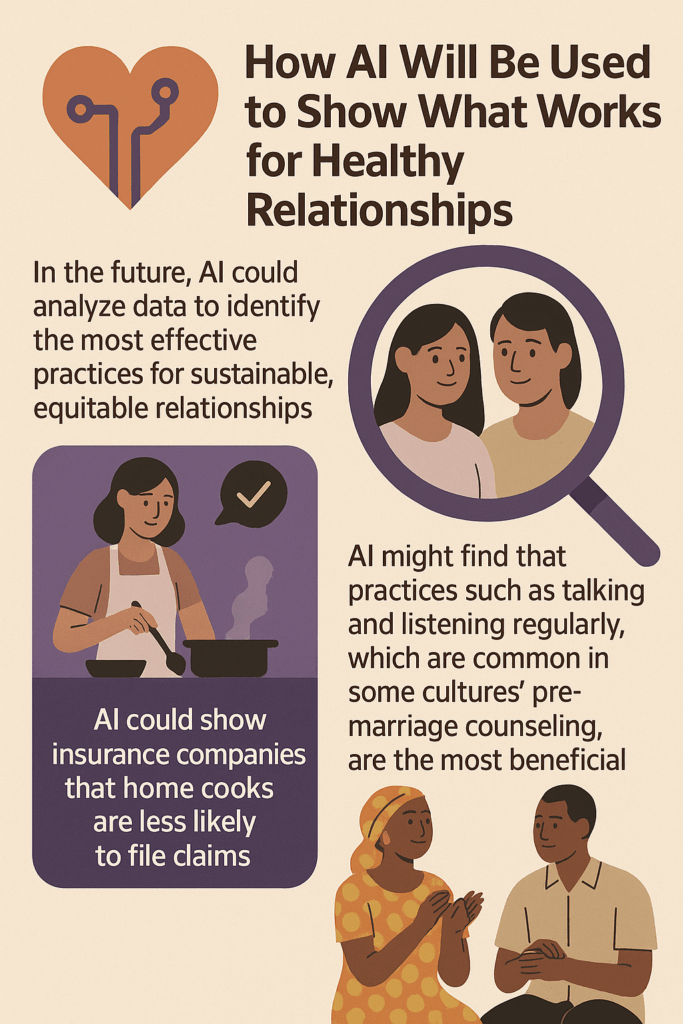
Artificial intelligence is reshaping everything from how we shop to how we date — and soon, it may unlock insights that could revolutionize our relationships. While often framed around productivity, security, and convenience, AI’s true potential lies in its ability to reveal what actually works—not just in business, but in our personal lives. Imagine a future where AI doesn’t just automate our calendars, but also helps us become better partners, friends, and family members.
Let’s take a closer look at how AI will play a vital role in helping us build equitable, lasting, and happy relationships — while drawing parallels from surprising real-world use cases like home insurance analytics.
AI is Already Showing Us Human Patterns — Even When We Don’t Realize It
Here’s a curious fact: some insurance companies have discovered that people who cook at home are statistically less likely to file home insurance claims.¹ It’s not magic — it’s data. Home cooks may be more present, more cautious, and more invested in their environment. AI sifts through millions of data points to find this kind of pattern — one that would be nearly impossible for a human analyst to identify.
Now apply this logic to relationships: What if AI could analyze decades of anonymized data — from couples therapy transcripts, social media posts, wearables, and surveys — to uncover which daily habits, communication styles, or conflict resolution strategies predict long-term happiness?
From Cooking Stats to Couples Therapy: The Bridge AI is Building
AI models are already being used to analyze speech tone, emotional regulation, and even eye movement during couples therapy sessions. In the near future, large-scale studies powered by AI could show us:
- Which relationship practices most predict mutual satisfaction after 10, 20, or even 50 years
- How cultural habits (e.g., family dinners, shared prayer, or storytelling) improve connection
- How physiological signs (like stress or sleep patterns) predict relationship satisfaction
- Which attachment styles respond best to certain communication techniques
Imagine apps that could give real-time nudges like: “Take a break — couples in similar situations report better outcomes when they pause the discussion here.” Or therapists using AI-generated reports that show which exercises were most helpful to similar couples across the world.
Cultural Evidence: We’ve Already Seen This Work
Let’s take a few global examples that reflect what AI is likely to confirm:
1. The Gottman Method (USA)
Psychologist Dr. John Gottman famously predicted divorce with over 90% accuracy by studying micro-expressions and conversational patterns.² AI can now scale this observational work to millions of relationships, fine-tuning what Gottman pioneered.
2. Premarital Counseling in Uganda
In many Ugandan communities, elders offer structured premarital counseling focused on listening, shared duties, and community accountability.³ AI could help us see how these traditions compare — and often outperform — modern Western relationship habits.
3. Japanese “Kansha” Practice
The concept of kansha (deep gratitude) is embedded in many Japanese couples’ daily rituals. AI might detect that simple thank-you’s, repeated consistently, correlate with long-term marital satisfaction — even more than grand romantic gestures.
Rethinking “Compatibility”: AI’s Most Powerful Promise
Many dating apps use algorithms to match us, but few use AI to track whether those matches worked long-term. As AI improves, it may shift the focus from initial chemistry to sustainable compatibility — factoring in values, resilience, and emotional regulation, not just hobbies and selfies.
Eventually, personal AI advisors may help couples navigate hard moments with greater empathy. Think: “Your partner’s stress patterns are elevated this week — here’s how couples in similar scenarios stayed connected.”
The Future is Personal, Ethical, and Data-Driven
Of course, this raises important ethical concerns: privacy, bias, and consent. Any use of AI in relationships must protect autonomy and dignity, not create surveillance-based control.
But if done responsibly, AI could help us shed harmful myths — like the idea that “love should be easy” — and instead reveal what actually works to sustain relationships built on mutual respect, equity, and joy.
As we stand on the edge of this technological revolution, one truth remains unchanged: Human connection is both our oldest story and our most endangered one. With the help of AI, perhaps we can write a new chapter — one rooted not in guesswork, but in truth.
Bibliography
- RiskGenius. “What Cooking Habits Tell Us About Home Risk.” Insurtech Weekly, 2021.
- Gottman, J. The Seven Principles for Making Marriage Work. Harmony Books, 1999.
- Nyanzi, S. “Pre-Marital Counseling Traditions in Uganda.” Journal of African Cultural Studies, 2010.
- Rai, T. “AI in Couples Therapy: Emerging Frontiers.” Journal of AI in Mental Health, 2023.
- McDonald, C. “Wearables and Emotional Tracking in Relationships.” MIT Tech Review, 2022.